The Challenge
Bringing a computer-vision model from a dataset to a deployable edge artifact is slow, manual, and expensive. An engineer trains a model, reads the curves, guesses a learning-rate change, retrains, and repeats — then separately wrestles with quantisation and export to hit a device's compute and memory budget. We wanted to prove that this entire loop could be automated end to end, with a reasoning agent making the optimisation decisions a human normally would.
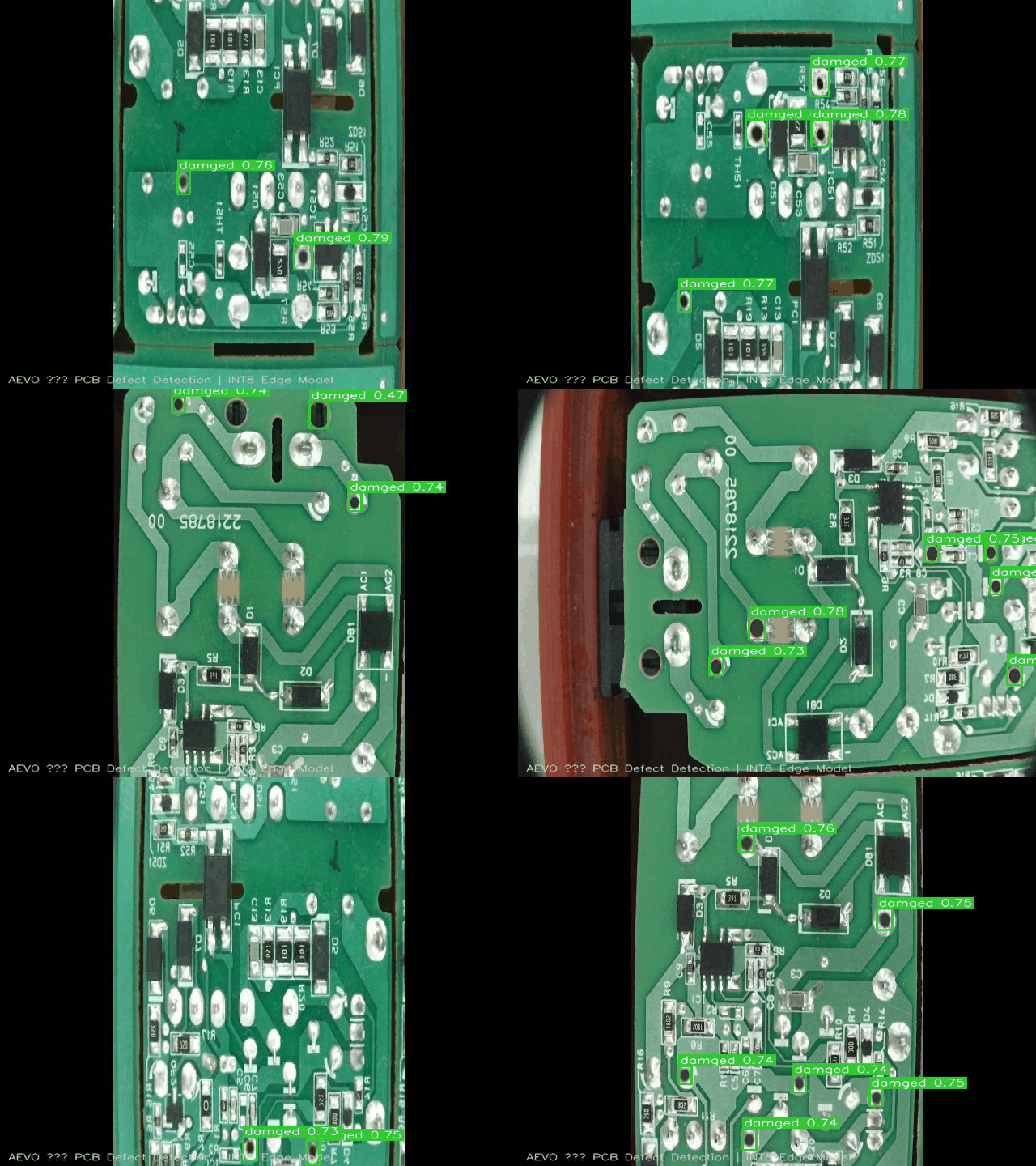
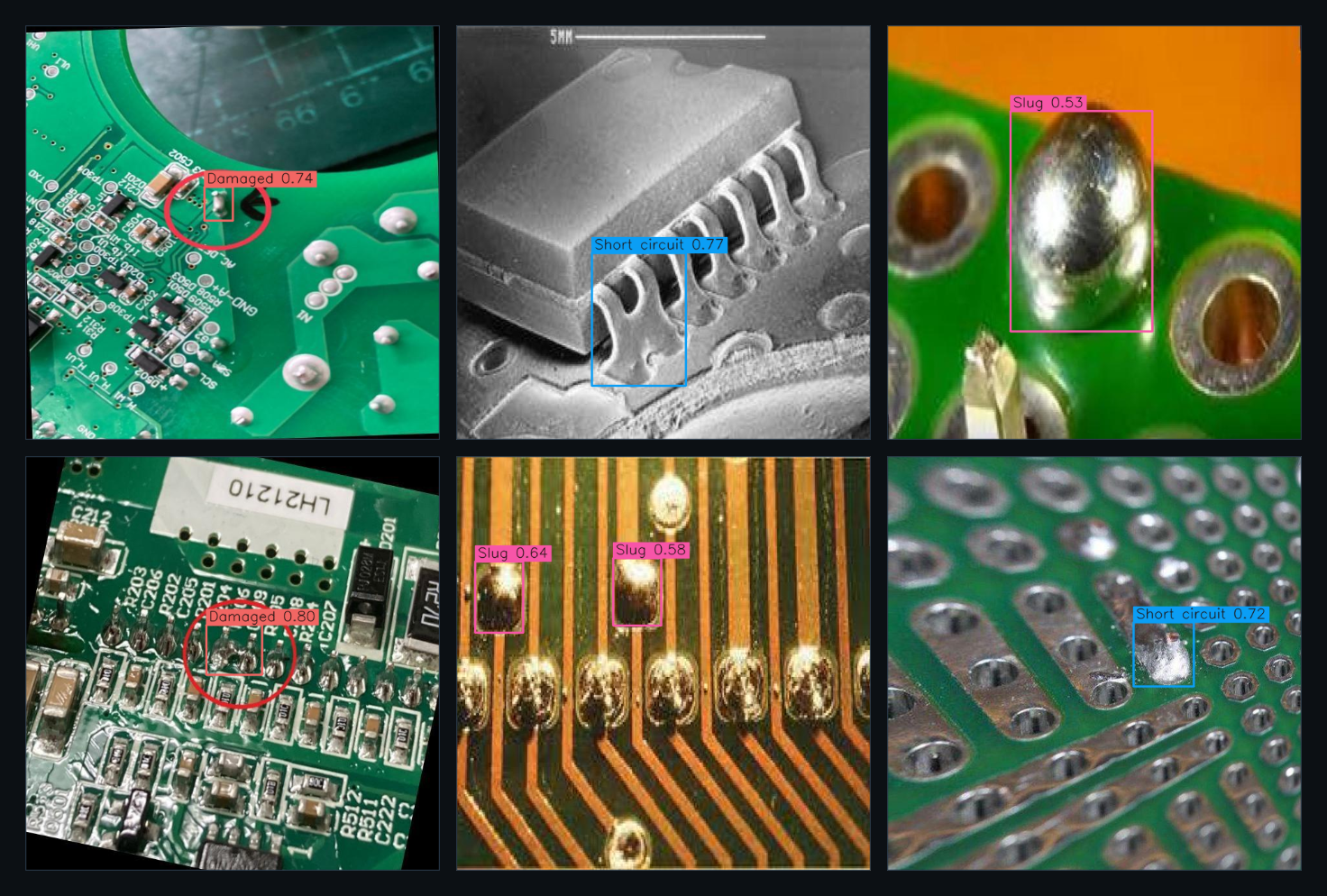
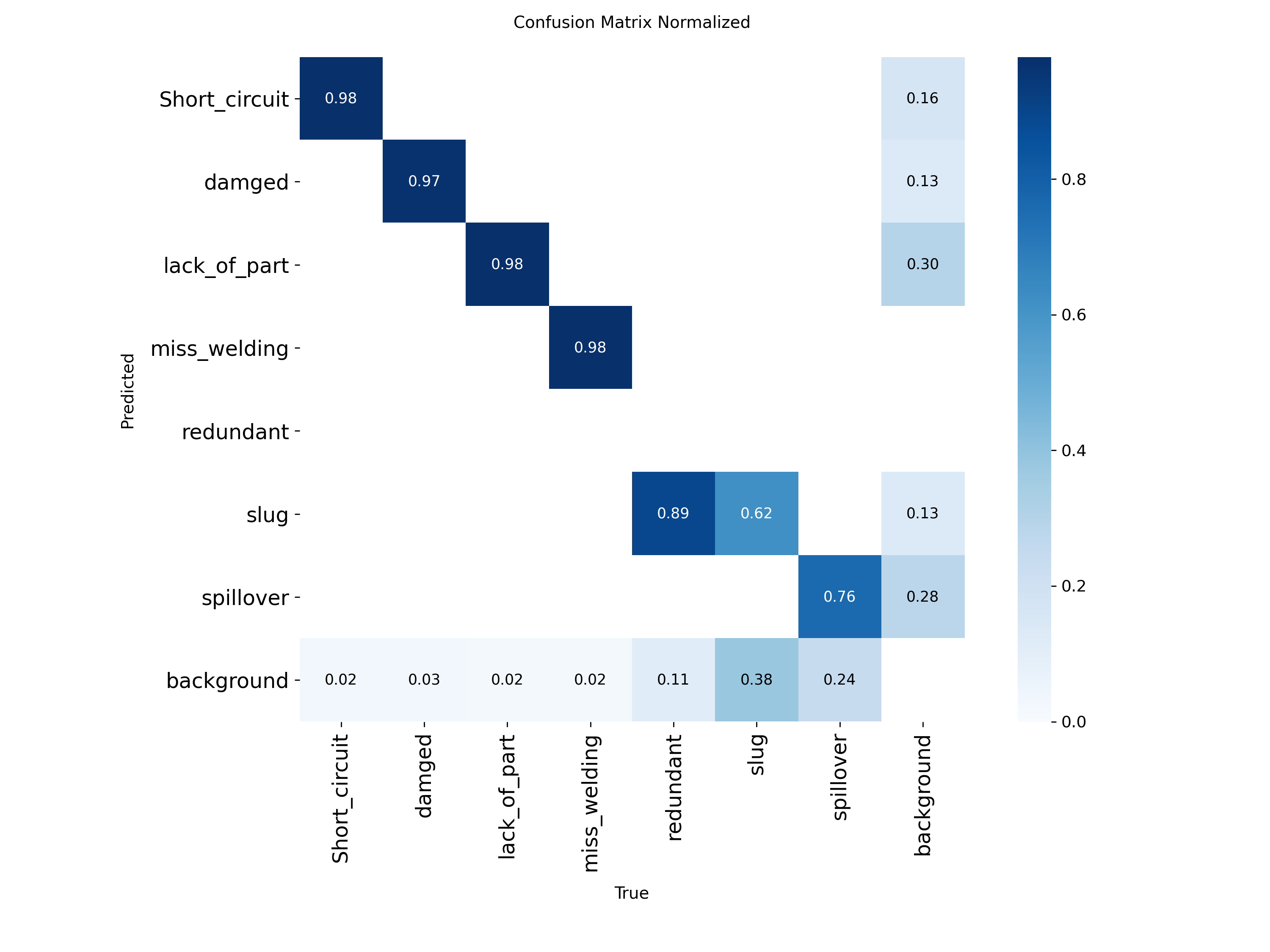
AEVO is ROVOQ's in-house demonstration of that idea, built on a real industrial problem: PCB defect detection across 7 defect classes, with a hard constraint that the final model must run fast on a CPU-class edge device.
What We Built
An Autonomous Training Loop
AEVO trains a YOLOv8n model on 22,476 real-world PCB images. Every 5 epochs, it serialises its recent training metrics and sends them to the Claude API, which returns a structured JSON decision — reduce_lr, adjust_momentum, or continue — together with a plain-language rationale. The pipeline applies the decision and keeps training. No human watches the dashboard.
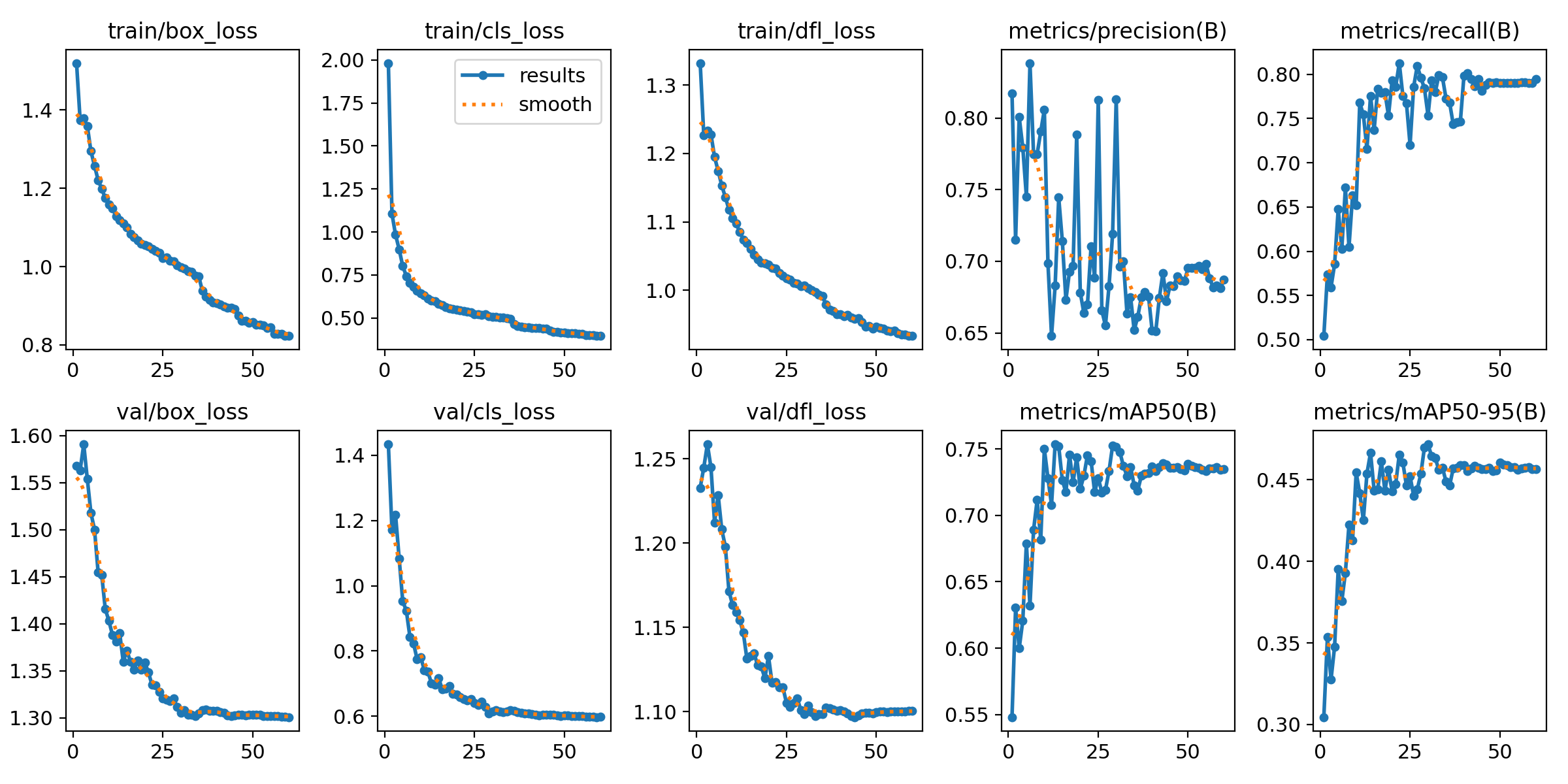
Epoch  35 | reduce_lr x0.5  — "val mAP50 declined 0.7477->0.7224 over 5 epochs"
Epoch  45 | reduce_lr x0.6  — "mAP50 plateaued at 0.735-0.739 for 5 epochs"
Epoch  55 | reduce_lr x0.5  — "mAP50 steadily declined 0.7375->0.7333"
Edge Compression Pipeline
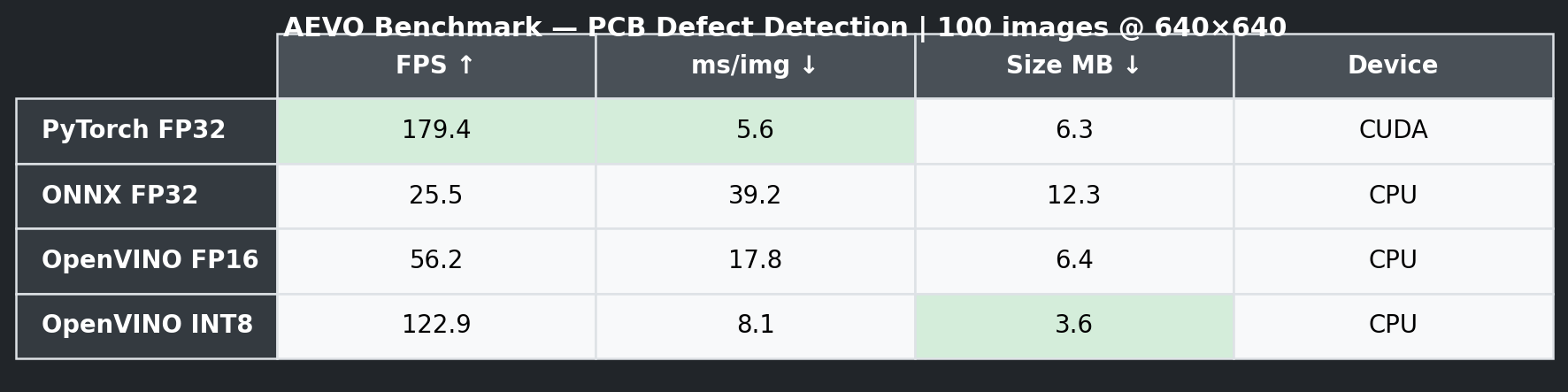
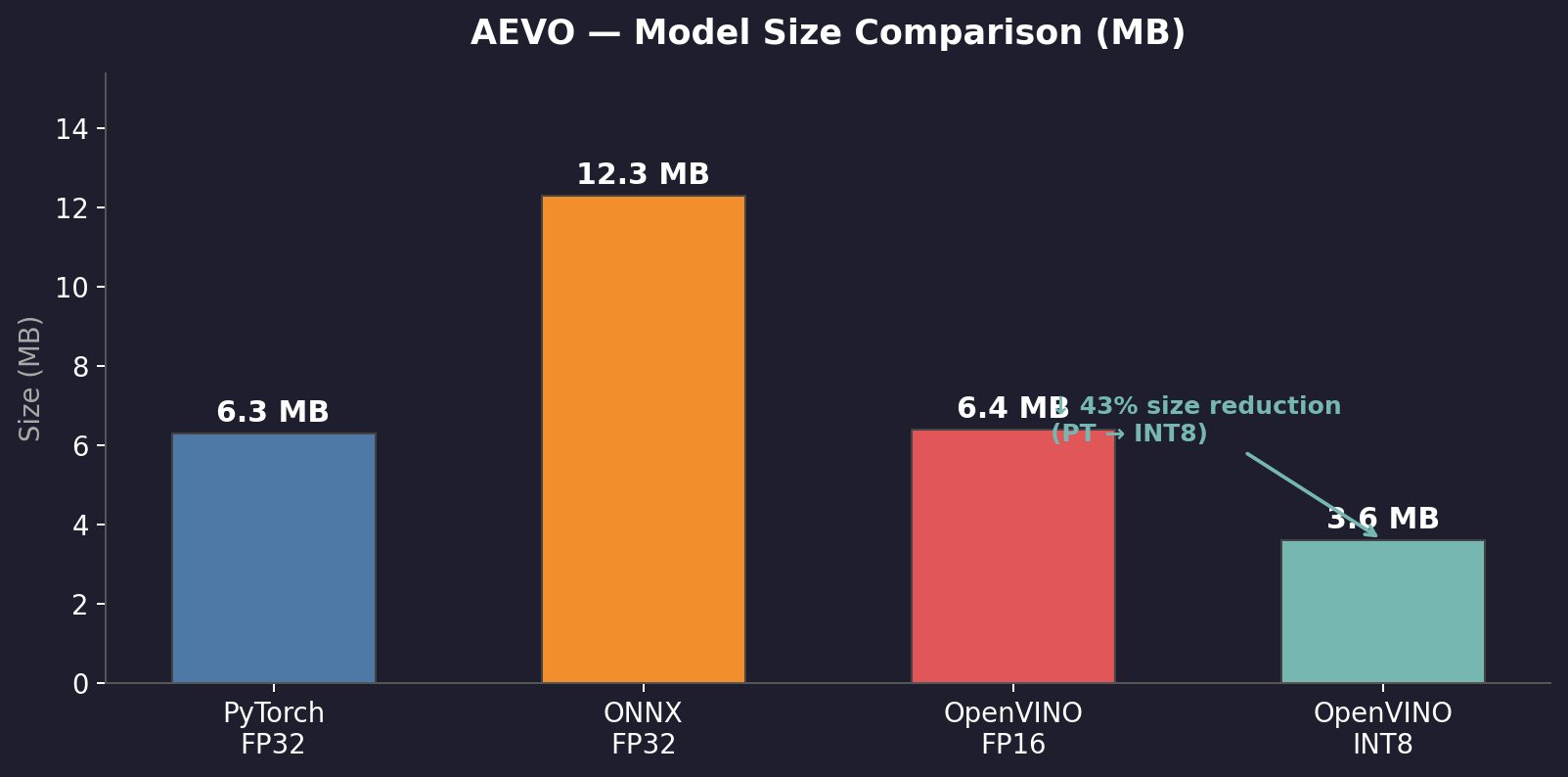
Once the agent locks in a best checkpoint, AEVO exports it through a compression chain — PyTorch FP32 → ONNX → OpenVINO FP16 → OpenVINO INT8 — and benchmarks every format on a 100-image set. The INT8 edge target lands at 3.6 MB and 122.9 FPS on CPU, with under 2% accuracy drop versus the full-precision model.
The Pipeline End to End
[Dataset] -> Module 1: Data Hub (validate + augment)
          -> Module 2: YOLOv8 Training Loop
               | every 5 epochs
               +-- Module 3: Claude Agent
                     analyse metrics -> JSON action
                     -> reduce_lr / adjust_momentum / continue
          -> Module 4: ONNX + OpenVINO INT8 compression
          -> Module 5: Benchmark Reporter (100-image inference)
Results
The agent made 12 API calls across the run and applied 4 learning-rate adjustments autonomously, converging to a strong detector that compresses cleanly to the edge:
Watch the Demo
A 94-second walkthrough of the full autonomous pipeline — training, the Claude agent's decisions, compression, and edge benchmarking:
Technology Stack
Why It Matters
AEVO shows how ROVOQ combines computer vision, agentic AI, and edge optimisation into a single automated workflow. The same pattern — autonomous training, LLM-driven decisioning, and aggressive compression for on-device inference — applies directly to industrial inspection, quality control, and any vision system that has to run cheaply at the edge rather than in the cloud.