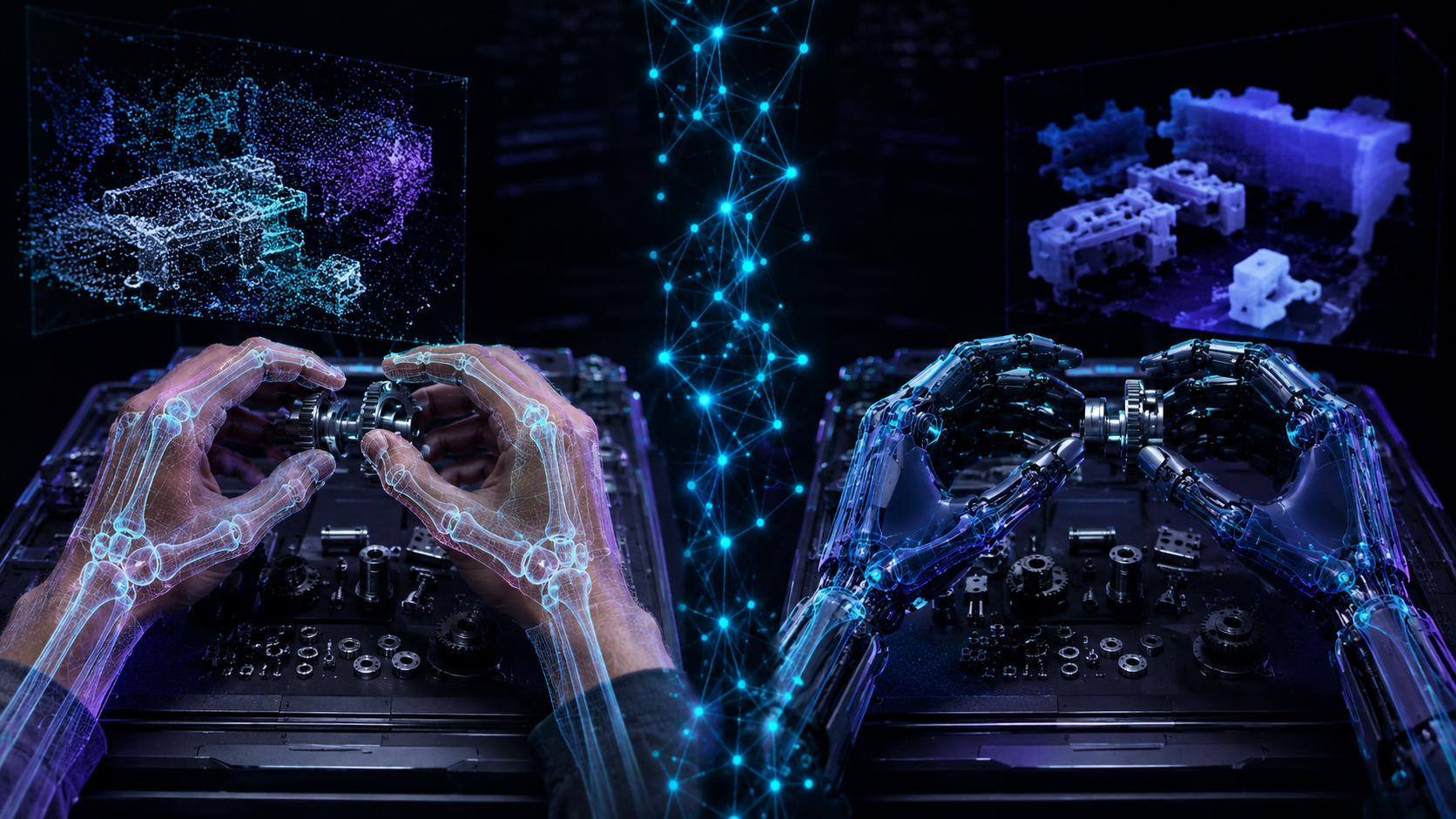
1. Overcoming the Dexterity Data Bottleneck with Nvidia's EgoScale
Historically, training robotic manipulation models — pick-and-place, assembly, tool use — required thousands of hours of expensive, teleoperated robot data. A human operator would physically guide a robotic arm through each motion, recording trajectories that the model could learn from. The process was slow, hardware-locked, and required purpose-built teleoperation rigs that most engineering teams cannot afford to operate at scale.
Nvidia's newly released EgoScale[1] framework bypasses this entirely.
What EgoScale Does
EgoScale is a human-to-robot transfer framework built on a radically different hypothesis: that the internet is already full of the data needed to teach robots dexterity — it just happens to be filmed from a human perspective. Rather than a simple imitation model, it uses a flow-based Vision-Language-Action (VLA) architecture — a vision-language model backbone paired with a DiT (Diffusion Transformer) action expert — and a unified wrist-level action representation that bridges the kinematic gap between human and robot embodiments.
By training on 20,854 hours of action-labelled egocentric human video — a dataset 20× larger than any prior work in this space — the Nvidia GEAR team discovered something with significant implications for how the industry trains dexterous robots.
The Scaling Law Discovery
The team identified a near-perfect log-linear scaling law (R2 = 0.9983) between the volume of human video data and validation loss — which correlates directly and predictably with downstream robot task success. This is the same class of result that defined the LLM scaling era, except applied to physical manipulation rather than language.
In plain terms: the more high-quality egocentric human video you feed the model, the better your robot performs at tasks it has never physically practised. The relationship is not just positive — it is remarkably predictable. You can model the expected performance gain before committing any robot hardware time.
"A near-perfect log-linear scaling law between human data volume and robot task success changes the fundamental economics of dexterity training. This is the LLM moment for physical manipulation."
Validated Tasks and Results
EgoScale was benchmarked on five dexterous manipulation tasks using a 22-DoF robotic hand, achieving a 54% improvement in average success rate over the no-pretraining baseline:
- Shirt rolling — deformable object manipulation with variable geometry
- Tongue positioning — high-precision fine-motor control
- Card sorting — sequential pick-and-place under spatial constraint
- Bottle manipulation — grasping and repositioning of rigid objects
- Syringe handling — tool use requiring controlled force feedback
The framework also transfers cleanly to lower-DoF hand embodiments and enables one-shot task adaptation with minimal robot supervision — meaning embodiment-specific lightweight adapters handle the kinematic differences without retraining the full model. None of these tasks required robot-in-the-loop data during pre-training. The robot policy was bootstrapped entirely on human video, then fine-tuned with a small amount of aligned human-robot "play data."
Scaling human motion data is now the most practical path to robotic dexterity. For manufacturing clients, this eliminates the need to spend months manually programming joint trajectories for every task variant. You pre-train the manipulation policy purely on human video data — which is abundant, cheap, and increasingly available in structured form — then fine-tune with minimal real-world robot play data. Deployment timelines that previously ran to quarters can now be measured in weeks.
The architectural implication: perception pipelines feeding these models need to produce egocentric representations consistent with the training distribution. That means ego-view camera placement, wrist-mounted IMU fusion, and egocentric depth priors are becoming first-class design choices in manipulation system architecture.
2. Production-Grade Monocular 3D Vision: The KV-Tracker
The second major shift of 2026 addresses a different class of problem: real-time spatial awareness in constrained or unstructured environments where deploying full sensor suites is not viable.
In constrained, dynamic environments — under-ice autonomous vehicles, unstructured warehouses, surgical robotics, inspection drones — relying on multi-camera LiDAR setups is not always feasible. The hardware is heavy, expensive, power-hungry, and mechanically vulnerable. Teams have been forced to accept degraded spatial reasoning or carry sensor payloads that compromise the mission.
What the KV-Tracker Solves
The KV-Tracker[2] is a recently published algorithm that enables advanced multi-view 3D vision models — models that previously required multiple calibrated cameras and significant compute — to track scenes and objects in real-time using just a single monocular RGB camera.
The core innovation is a key-value caching strategy applied to the internal representations of 3D vision transformers. Instead of recomputing the full scene representation at every frame — which is where the computational cost historically concentrated — KV-Tracker retains and updates only the visual information that has changed between frames.
The Architecture Behind It
Traditional multi-view 3D reconstruction models use a cross-attention mechanism that attends over the full scene context at every timestep. For a transformer-based architecture, this means O(n²) attention complexity over all spatial tokens — computationally intractable at real-time frame rates on edge hardware.
KV-Tracker's insight is that in a tracking scenario, most of the spatial scene does not change between consecutive frames. The algorithm:
- Computes the full scene key-value representation on the first frame (the "keyframe")
- Caches this representation in memory
- On subsequent frames, computes only the update delta — what has moved or changed — and attends over the cached context selectively
- Periodically re-anchors the cache when cumulative drift exceeds a confidence threshold
This reduces the per-frame attention cost by an order of magnitude, yielding the 15× speed-up observed in benchmarks, while maintaining spatial accuracy comparable to full-scene recomputation.
Integration with ESKF Pipelines
For teams already running an Error-State Kalman Filter (ESKF) for IMU-visual fusion — a standard architecture in visual-inertial odometry and SLAM systems — KV-Tracker slots cleanly into the vision front-end. The monocular depth and pose estimates it produces serve as the measurement update step in the ESKF, while the IMU provides the high-rate propagation model.
# Conceptual ESKF update with KV-Tracker monocular pose
class ESKFPerceptionPipeline:
    def propagate(self, imu_measurement):
        # High-rate IMU propagation (e.g. 400 Hz)
        self.state.propagate(imu_measurement)
        self.covariance.propagate(imu_measurement)

    def update_vision(self, rgb_frame):
        # KV-Tracker produces 6-DoF pose + depth at ~27 FPS
        pose_meas, depth_map = self.kv_tracker.track(rgb_frame)

        # Measurement residual in error-state formulation
        residual = pose_meas - self.state.predicted_pose
        K = self.compute_kalman_gain()
        self.state.apply_correction(K @ residual)
        self.covariance.update(K)
The result is a tightly coupled monocular-inertial pipeline that achieves robust 6-DoF pose estimation and on-the-fly 3D reconstruction on hardware as lightweight as an NVIDIA Jetson Orin NX — without any LiDAR, stereo rigs, or structured light sensors.
Real-time 6-DoF pose tracking and on-the-fly 3D reconstruction are now viable on lightweight, low-power edge hardware. When integrated with an ESKF framework, KV-Tracker enables us to extract robust spatial geometry and object tracking without multi-camera or laser-triangulation dependencies.
This matters most for deployments where sensor payload is a hard constraint — inspection drones, miniaturised surgical robots, wearable teleoperation systems, and any field robot where SWaP (Size, Weight, and Power) is a primary design driver. For SLAM-dependent navigation, it opens the door to monocular-first architectures that were previously too slow to be considered production-grade.
The Future is Agentic
These two breakthroughs do not exist in isolation. They are part of a broader convergence that also includes Nvidia's GR00T N1 platform[3] — an open foundation model for humanoid robots trained across diverse manipulation and locomotion tasks — and Physical Intelligence's π₀ (pi-zero)[4], which introduces flow-matching policies capable of planning and reacting to unstructured physical environments in real time.
What connects EgoScale, KV-Tracker, GR00T, and π0 is a shared architectural assumption: the future of autonomous systems is not a stack of hand-tuned controllers. It is a perception-grounded world model that understands the physical environment well enough to generate appropriate behaviour without explicit programming of every edge case.
What This Means for Industrial Deployment
The shift has concrete implications for how industrial automation projects should be architected starting now:
- Stop hardcoding joint trajectories. Trajectory programming is becoming a maintenance liability. Systems architected around learned policies that generalise across task variants will have substantially lower long-term engineering cost.
- Invest in perception infrastructure early. World models are only as good as their sensory inputs. The teams that will have an advantage in 2027 are the ones building robust, calibrated, temporally consistent perception pipelines today.
- Decouple the sensing layer from the action layer. With modular pre-trained models like EgoScale handling manipulation and KV-Tracker handling spatial awareness, clean interface boundaries between perception and planning are essential for composability.
- Prioritise egocentric data collection. If you are operating physical hardware today, instrument it for ego-view capture. That dataset will be directly usable for fine-tuning EgoScale-class models. Hardware that runs without collecting training data is leaving future capability on the table.
The Real Moat is the Perception Layer
Hardware is increasingly commoditised. Humanoid robot bodies, articulated arms, and wheeled platforms are available from multiple vendors at competitive prices. Foundation models like GR00T and π0 will be accessible through APIs within the next 12–18 months.
The defensible engineering advantage — the moat that will separate systems that work in controlled demonstrations from systems that work reliably in unstructured real-world deployments — is who builds the most robust perception layer on top of these foundations.
Sensor fusion. Calibration pipelines. Temporal consistency under lighting change and occlusion. Edge-optimised inference. These are not glamorous problems, but they are the ones that determine whether a robot completes its task or fails in the first 30 seconds of a real deployment.
The hardware is ready. The foundation models are arriving. The remaining variable is whether your perception stack can give those models an accurate, reliable picture of the physical world at the speed they need it.
Final Thoughts
If the last few years were about AI learning to talk, 2026 is the year AI learned to move. EgoScale proves that human motion video is a first-class training signal for physical manipulation — one that scales predictably with data volume. KV-Tracker proves that real-time monocular 3D vision is no longer a research curiosity; it is a deployable edge primitive.
Together, these breakthroughs make the architectural case for "brains-first" robotics: systems designed around world models and learned perception, rather than brittle scripts and hardcoded kinematics. The teams that make this architectural transition now will be the ones deploying production-grade autonomous systems while their competitors are still programming joint angles by hand.
At ROVOQ, this is exactly the work we do — bridging complex AI perception with advanced robotic kinematics to build algorithmic systems that allow hardware to figure out where it is in the world and what to do next. If you're thinking about this transition for your industrial hardware, let's talk.
References
-
[1]
Zheng, R., Niu, D., Xie, Y., Wang, J., Xu, M., et al.
EgoScale: Scaling Dexterous Robot Learning with Egocentric Human Videos.
NVIDIA Research / GEAR Lab & UC Berkeley, 2025–2026.
research.nvidia.com/labs/gear/egoscale ↗ -
[2]
KV-Tracker: Real-Time Pose Tracking with Transformers.
arXiv:2512.22581, December 2025.
arxiv.org/abs/2512.22581 ↗ -
[3]
NVIDIA Research.
GR00T N1: An Open Foundation Model for Generalist Humanoid Robots.
arXiv:2503.14734, March 2025.
arxiv.org/abs/2503.14734 ↗ | developer.nvidia.com/isaac/gr00t ↗ -
[4]
Physical Intelligence.
π₀: A Vision-Language-Action Flow Model for General Robot Control.
arXiv:2410.24164, October 2024.
arxiv.org/abs/2410.24164 ↗ | pi.website/download/pi0.pdf ↗